Small Businesses: Beware of Online Marketing Offers from Your Local Paper
This is longer than most of my posts. But I’m really het up! Music-wise, no relevance. I just picked something that always makes me feel happy and relaxed – Flor de Lis by Djavan.
These days, when you’re convinced you should be advertising in your local paper, your newspaper ad rep will likely be trying to sell you an array of online services. Some – like Hearst Media CT — will even offer you a dollar for dollar match of print advertising for every dollar you spend in online advertising. Sounds great, right? Now my $10,000 budget just became worth $20,000. Yes, but by what metrics do you determine the value of this offer. Right off the bat, the offer implies that the print publications are worth zero.
I am all for effective integration of online/offline marketing. However I’m finding that as traditional media – especially newspapers – transition their businesses online, there are some big pitfalls for unwary advertisers.
Case in point: I recently launched a new medical practice that draws from a pretty local market. We built a website and carefully optimized it for organic search. We registered the site in the key local search directories – Google, Yahoo! And Bing and quickly began coming up #1 on page 1 for our important terms.
The partners in the practice wanted to launch with some local traditional advertising as well. We canvassed the local media for print and online ad rates. In our area – Fairfield County, Connecticut — Hearst Media now owns four daily papers in all but one of the biggest cities and a time-honored chain of weeklies that covers some of the key smaller towns.
Hearst said to us: Whatever your ad spend online and in a targeted bi-monthly health/lifestyle magazine, we’ll give you a 100%, dollar for dollar match in print advertising in our other publications.
Here’s the rub. What is the online ad spend really worth. The promise is that there’s lots of analytic data to evaluate the online ROI, but the reports are a real disappointment. We bought visibility on three daily paper websites with geo-targeting to three local weeklies. The problem is that Hearst can’t break out the geo-targeting.
The rates are based on CPM – how many impressions – not click throughs. Unfortunately the sales staff is not well-informed and the analytics not precise enough to offer any advice on placement, aggregate analysis of what constitutes a good CTR, or anything that can be helpful to a marketer trying to get value for a client.
Then there are deceptive ‘SEO’ programs that are sold as collaborations with Google and other search engines to get you to come up higher in search rankings. No one at Hearst could really explain the program to us. The best we got was that you get a landing page on the back end of their site. Does it have a backlink to our site? I asked. Yes I think so.
Here’s what the SEO program turned out to be.
Hearst set up a landing page optimized with the same search terms we used on our site. They grabbed copy from our website, cobbled it together, wrote and added some factually incorrect copy that they never submitted for approval. They established a tracking phone number that pointed to the client’s phone number. The tracking number’s reason for existence was to prove to us that Hearst had pointed calls to us from this landing page. A visitor who was interested but not ready to call might write this number down and if they called it two months later when we were no longer advertising with Hearst, they would certainly think we were no longer in business.
The more agregious thing that Hearst did was to steal our entire website code and recreate the site under a new url – the same as my client’s but with a 1 added to it. They changed the phone number on every page of that site to their tracking number. The bogus site was optimized with the same search terms as our original site to drive traffic for our terms to the Hearst websites. So basically, they put us in competition with ourselves in organic search. They took the video we supplied them for the landing page and uploaded it to a YouTube account that used the client’s name and again pointed those who clicked to their site – not ours.
Worse yet they were charging us to put us in a situation where Google could demote our legitimate search engine rankings for duplicate content.
Who are they designing this for? Maybe if you’re a very small local business and you have no website or web presence, Hearst and others providing similar products – the other daily in our area The Hour has something similar – might help you establish some online reach that you wouldn’t otherwise have. But if you’re a small business that has invested in your own website, SEO and online reach – do not, I repeat DO NOT buy such a service. Take the money and create a blog, hire a good, local SEO consultant to optimize your site. (BTW – you can’t come up on page one for $35 per month for any really meaningful search terms.)
Maybe you’d be better off buying a banner ad on the newspaper’s site with a link to your site or see if you can get them to give you a direct back link from their site via some content you provide – which could be worth a lot to you. But in my experience you can’t really get meaningful reporting to help justify the investment in these programs. These new newspaper offerings are not malicious, just part of an evolution in marketing. But they are potentially damaging, nonetheless. Get yourself up to speed and be part of moving media toward truly mutually beneficial solutions.
Read Full Post | Make a Comment ( 2 so far )Give Pieces a Chance: A Case for Integrated Marketing in the Digital Age
Here are a few disparate but related thoughts that will roll into the topic of this post – how to make integrated marketing a reality. Today’s musical post is Pieces of Dreams, a jazz standard sung by Sarah Vaughan, backed by the orchestra of Michel Legrand, its composer.
The song title connects to the post title: Give Pieces a Chance. Now, I could have selected the John Lennon/Yoko Ono hit about ‘peace’. But I really wanted to stick with the idea of ‘pieces’ – read ‘tactics’ — and their relationship to successful integrated marketing.
So, the Legrand song seemed to be a better tactical choice in support of my strategic objective – to start a useful discussion about integrated marketing. Also – I believe that true integrated marketing is sitll a dream. And – the song had double appeal because an excellent jazz band Pieces of a Dream – who hail from my home town of Norristown, Penna and used to play at our family’s parties – derived its name from this same Michel Legrand tune.
Call me sentimental! Marketing is about emotions after all! But there’s definitely an intellectual piece first…
Integrated marketing in the digital age. Here’s why I decided to write about it again. Earlier today I read and commented on a wonderful blog post by Jill Adams, CEO of Adams & Knight, an integrated marketing agency. Her post was titled “Stop Chasing Digital Crazes: Tomorrow’s Top Brands Will Be Led by Fusion Marketers – Not Social Media ‘Gurus.’”
After reading her post, what I recognized is that the integrated marketing battle is no different today than it’s ever been — except for the fact that we have many more tactical tools to choose from and that there is more of a willingness to at least consider blurring the boundaries between various marketing disciplines. Historically there have been turf wars for both budgets and bragging rights among various contributors that have negatively impacted results.
Even though I come out of PR, I’ve made it a point to understand the big picture in order to be able to support various marketing pieces with media visibility. ‘Big picture’ is the operative term here because you have to see the big view to identify overall objectives and strategy. Then it’s a question of having a big tool box. No one person can implement all of the important efforts, so we need to collaborate with trusted colleagues who can bring their expertise to bear – everyone with an eye on what will move the ball ahead to the objective.
What will work is different for every project, assignment and initiative, which takes flexibility and ever greater creativity. What’s most important for success is how we think about each effort. THINK!!!!!!! Thinking is at the root of the creative process. It’s not what we know about Twitter or Facebook or a flave of the week digital offering that will achieve success for our brands.
Yes we have to keep informed as never before because everything cycles through so fast. But we have to think about what we want to achieve, what the best tools are to get there, who else we need to collaborate with to make it happen. If we don’t think about the tactical pieces of what we’re doing in terms of the strategic whole, they’ll never have a chance of getting us to success.
Now this post has been very theoretical. Next time I’ll share some recent client projects to give you a more practical view of marketing integration.
Please jump in to share how your strategic vs tactical thinking works – whether or not you’re a marketer.
Read Full Post | Make a Comment ( None so far )A Bricks and Mortar Model for Human Business on the Web
Today’s musical post is Scrapple from the Apple, a 1950-60’s classic throwback featuring Gene Ammons on tenor sax, Eddie Buster on Hammond B-3 organ, and Gerald Donovan on drums. Read on for the relevance.
Every time I work with a client to establish a human approach to online marketing, my thoughts turn to Sneddon’s in Lambertville, N.J., across the Delaware River from New Hope, Penna. 
This wonderful, family-owned business is in its third generation of Sneddon ownership. Earlier it was known as Mutzie’s – a childhood hang of chef Gabrielle Hamilton whose book Blood, Bones and Butter at this moment tops the NY Times and Amazon best-seller’s list.
Walk into Sneddon’s and you’ve time travelled back to a 1950’s luncheonette with booths along one perimeter, formica-topped tables down the middle and a long counter on the other side with swivel stools facing the griddles and food prep surfaces. 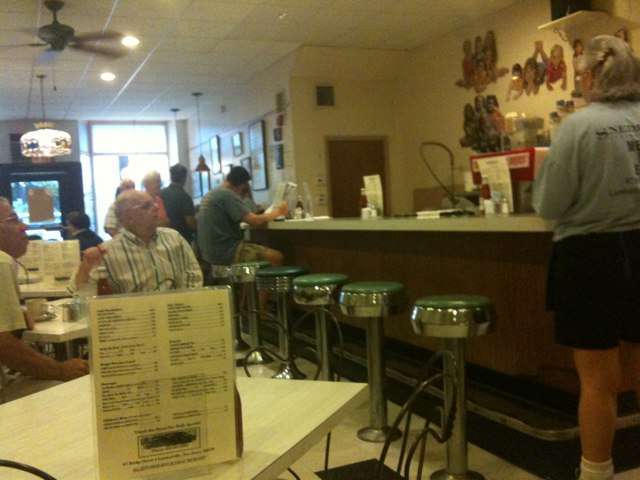
This picture of the interior of Sneddon’s courtesy of UrbanSpoon.com includes our favorite waitress Terry standing at the counter.
Sneddon’s is a community of locals, sophisticated, part-time/weekend residents from New York and day tripper tourists – all of whom are attracted by the friendly, unpretentious atmosphere of the place.
It delivers what its community values – simple, high quality food prepared with pride, reasonable prices, and a staff – from dishwashers, to cooks, to waitresses, to owners — that embraces the customers, remembers them by name, stops by their tables to chat and exchange updates on family, news, the weather and how their experience at Sneddon’s is going that day. I’m always confident that my eggs over easy and well-done Philly scrapple – a local breakfast meat – will come out prepared as ordered.
My mother has been lunching there almost daily for years, first with my stepfather and mentor John Walsh who died several years ago. The Sneddon’s folk have lived through my mother’s joys, health problems, community involvement, death of John with care and concern. I know that if she didn’t show up for lunch for more than a day or two they’d call her and if they felt it necessary dispatch someone to her home to be sure she was ok or help her in any way possible.
Since the Sneddon’s have owned it, the business has passed through three generations. Some days, all three generations are there — the current owners working, the previous ones stopping by to say hello or to bring fresh produce that they grow and contribute to the kitchen.
The staff – local and culturally diverse – also has family stopping in for an after-school snack or some other touchpoint with the loved one employed there. The whole environment is relaxed, friendly, no tension – a real pick-me-up regardless of what’s going on in life.
I try really hard to replicate something of the Sneddon’s experience on the websites, Facebook pages and other online communities of every client, regardless of what business they’re in. Sneddon’s is a successful, busy beehive full of hard-working and happy people. Its human spirit is something for other businesses to aspire to.
Please share your human business role models!
Read Full Post | Make a Comment ( 3 so far )How the Worm is Turning for Newspapers
This post is about the continuing – and increasing pace of – the evolution of print newspapers into online entities. The musical post is not directly related. It’s a tribute to Joe Morello, the iconic drummer of the 1950s and ‘60s Dave Brubeck Quartet whose solo on Take Five is a jazz classic. We lost Joe this past week.

If there’s a thematic connection, it’s in the idea of evolution. Joe Morello helped evolve the way we think about rhythm. Listen to his killer technique on Far More Drums (in 5/4 time) from the album Time Further Out. Other personnel are Brubeck, piano, Paul Desmond, sax, Eugene Wright, bass.
Three things came to my attention this week that magnify the rapid move of newspapers away from a print platform. Two of them were widely reported.
• The L.A. times reported results of a study that show for the first time that online readership surpassed print readership by 46% to 40%.
• The New York Times announced it will erect its online subscription paywall on March 28.
I learned of the third thing as I worked with a client launching a new kind of medical practice who wanted to do some local print advertising here in the Fairfield County, Connecticut market. Over the past few years, Hearst Media has acquired all but one of the major dailies in the county, as well as a well-read chain of weekly community papers. I asked our sales rep for her help in putting together a three-month advertising plan in three of their community weeklies.
She proceeded to explain that for every dollar my client spent advertising online – which would include visibility on three major dailies and geo-targeting to the weeklies – and in a health and fitness-related magazine title, Hearst would match the spend 100% – dollar for dollar — in newspaper print advertising. That meant that a $10,000 budget, for example, would have a $20,000 equivalency.
It was a no-brainer for the client to cover both traditional and online bases for its original budget. And it made an enormous statement about the value being placed on print newspapers by the publisher. Even though the online advertising might be a bit pricey, we’ll know if it’s worth it when we get the traffic, page view and click-thru reports. There was no contract required so opting out is no problem.
A newspaper publisher giving away print to build online ad spends. Time was – til recently – that it was the other way around. The worm is most definitely turning!!
Read Full Post | Make a Comment ( 2 so far )Linked In Does Not Equal Opt In
Today’s tune – “Hearts Take Time” sung by blues/jazz vocalist and pianist Diane Schuur – refers to a romantic relationship gone wrong. This post is about the customer/client relationship online and how to begin and nurture it — starting with how not to.
Earlier this week, I received a Linked In invitation from an acquaintance who I know recently changed careers and is now in the financial services industry. I met her through someone I’m very close with and who has known her for many years.
She sent the invitation from her personal Linked In profile, which listed her by her nickname and gave her personal email address for contact. I like this person and promptly accepted her invitation.
Later the same day I received two emails in a row from her business email address. One informed me that she had added my email address to her marketing list and that I would be receiving information from time to time. The other was a sales message offering me products and services that I had never inquired about.
Both emails did have opt-out links. But that put me in the somewhat awkward position of letting this person know that I do not want to be contacted further about business.
She made the incorrect assumption that my accepting a Linked In invitation was an open invitation to be marketed to. My emotional response to that was very negative. I felt that it was a violation.
My reasons for connecting on Linked In are to widen my network, to refresh my memory about who I haven’t been in touch with for too long, to learn and to share information. Many other reasons, too. None of them is to make myself a target for an unsolicited sales pitch. By the way, this goes for all social media I engage with. In addition to a breach of social media etiquette, this person at best showed lack of knowledge and at worst bad judgment, which does not inspire confidence.
If she had taken a different approach, there’s a possibility that we might have done business together. She could have sent me a personal email asking whether I have any current needs in her area of expertise and/or pointing me in the direction of some info about her business offerings to build credibility in the event I knew of someone else who could benefit.
If I did indicate some level of interest, she could then use the opportunity to ask me to opt in to her list with the clear understanding that I could feel free to opt out at any time – that an opt-out would not have any impact on our personal relationship.
Even though it’s well-known that permission-based marketing works best, business people regularly ignore this best practice. If you do so, recognize that you may very well permanently kill an opportunity to develop a meaningful business relationship – including ongoing referrals – over the longer term. Hearts take time!!
Read Full Post | Make a Comment ( 1 so far )What’s the Semantic Web? Watch Jeopardy!
Over the past couple of years I’ve attended several presentations on Web 3.0 – aka the Semantic Web – which has been touted as the next great thing online. Unfortunately, the presenters were all tech people who were unable to really explain, “What is it?”
Last night I got a really good idea when I watched IBM’s latest challenge to human intelligence, the computers collectively known as ‘Watson’, play ‘Jeopardy!’ against two of the show’s all-time top winners – Ken Jennings and Brad Rutter. The result of the first of three nights of competition was a tie between Watson and Rutter. A stunned Jennings came in a very distant third. (In honor of Watson’s ‘maiden voyage’, today’s tune is Herbie Hancock’s tune of that name played by the composer and a stellar quintet. You’ll finish reading before it’s over, but stick around and listen if you’d like.)
Until last night I had the general sense that the Semantic Web had to do with contextual responses to search queries. In other words, currently search engines simply find keywords in text on web sites and blogs that seem to match a query. Applications on the semantic web would determine the meaning of the query, text or other data and then create connections for the user. Still not so clear.
I did a Google search for ‘example of semantic web search’ and it yielded a mess of results – none of which really answered my curiosity. However, the Wikipedia result offered at least a true vision of the Semantic Web as described in 1999 by Tim Berners-Lee, director of the World Wide Web Consortium and coiner of the phrase. In an online parallel to Martin Luther King’s famous speech, he said:
“I have a dream for the Web [in which computers] become capable of analyzing all the data on the Web – the content, links, and transactions between people and computers. A ‘Semantic Web’, which should make this possible, has yet to emerge, but when it does, the day-to-day mechanisms of trade, bureaucracy and our daily lives will be handled by machines talking to machines. The ‘intelligent agents’ people have touted for ages will finally materialize.” (Interesting note: If you click on this ‘intelligent agents’ anchor text it will take you to another Wikipedia page that will confuse the hell out of you. ;-})
Anyhow, last night I watched in amazement as Watson properly interpreted most of the questions, ‘pushed his response button’ and weighed in first with correct answers (actually questions in Jeopardy! terms) in an appealing non-computer-y voice. And I got it! This is what the Semantic Web will mean. Actually it reminded me a bit of Oz behind the curtain. 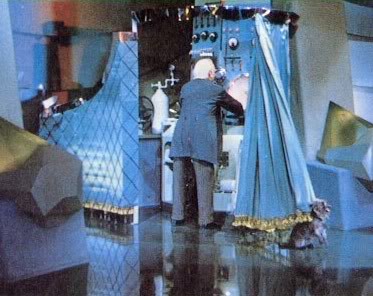
And an article in today’s Boston Globe described the game show experiment in more specific terms, “IBM scientists launched the Watson project to test whether a computing system could rival a human’s ability to answer questions posed in natural language with speed and accuracy. The “Jeopardy!’’ format was chosen because the game’s clues require analyzing meaning, humor, riddles, and other subtleties that humans can process, but are difficult for computers.” Difficult until now it looks like!
I’m looking forward to tonight’s continuation of the man-machine contest and its denouement tomorrow evening. Even though Watson appears to offer an exciting peek into the future, I can’t help but root for Ken and Brad. May the best – er – intelligent agent win!
Read Full Post | Make a Comment ( 3 so far )Snow Time Like the Present: OMG
Given the hard, snowy winter we’re suffering here on the east coast, it’s not enough to ‘think spring’. I’m going right to ‘Summertime’ as interpreted by the great pianist Kenny Drew, Jr. with Peter washington on bass and Lewis Nash on drums. Feelin’ warmer already!
The big new snowfall here in Norwalk kept me from the gym yesterday. But I’m tough and toned from shoveling the endless inches/feet of snow that keep falling on us. Frustration abounds in the New York metro – and undoubtedly right up the I-95 corridor from south to north – from at least DC to Maine. We’re breaking all-time snow records.
The morning of the snow, all of my neighbors and my recent snow shoveling helper – a US army vet out of work, taking the initiative to earn some bucks helping people dig out – were on the street shortly after daylight. We overcame earlier confrontations over who was dumping snow on whose property in favor of attacking a mutual problem. Too much snow, too little room to put it.

It’s never really thawed since the first of the seven storms we’ve dealt with so far. It’s almost comical how high the snow piles are getting. I’m actually kind of proud of myself that I have the strength to heave heavy shovels-ful of water-laden snow up to the top of four-to-five-foot heaps. The regular exertion is taking away all guilt at solacing myself with ice cream for dessert.
Shared anxiety about weather-related set-backs is bleeding through to business communications. My clients, colleagues and I are doing our best to keep things moving forward, while sharing the human emotions around dealing with circumstances over which we have no control.
My team and I are very goal oriented and driven to complete client projects in a timely fashion. When obstructed from our goals –regardless of why – we suffer and so do our clients. Time is money –truly. So when projects are delayed for whatever reasons it costs us all.
Given that mind set, it’s a real adjustment to deal with an out-of-control winter. During the time I had mapped out to write website content for a client, I had to shovel snow before it turned to hard, unmovable ice. I left my Twitter and Linked In communities to join my real life social network – my neighbors — as we dealt with how to move tons of snow pushed across our driveways by snow plows and related issues — like where to put it. Yesterday the levels of frustration reached a point of hilarity. The only reasonable thing to do was to laugh together while we shoveled.
Today all that’s predicted is a fast-moving ‘Yankee Clipper’ system that will spray us with a dusting to an inch of snow – and hopefully that’s all. I got up extra early to make up for lost productivity. But I must admit that I enjoyed the snow-day atmosphere of this latest depressing storm.
How do you cope with what’s out of your control?
Read Full Post | Make a Comment ( 2 so far )My NY Times Electronic Edition: Ending a Moral Dilemma
What are you doing New Year’s Eve? While you read my last post of the year, enjoy saxophonist Houston Person and friends asking that question in their swingin’, jazzy way.
In addition to writing one last post, I decided to end 2010 by finally changing my New York Times paper subscription to the Electronic Edition – a day ahead of the Times’ new pay policy for online-only readers. I’ve been working my way to this moment gradually.
A while back I downsized from daily to the ‘Weekender’ subscription. Most of my papers were going into the recycling bin unopened. I had lost the luxury of time to sit and read the paper leisurely over coffee and instead began grabbing the Times news headlines and my favorite features online.
Even with the weekend-only change, I still ended up tossing out most of my papers unread and decided to go to the online only subscription. Now it’s interesting to know that the Times will allow us to change our home delivery subscriptions online. But if you want to ditch paper in favor of bytes, it’s not so easy. It requires a phone call. And voice mail hell offers every option but switching to an online-only subscription.
When I finally got a ‘customer service’ rep on the line, she practically begged me not to go all-electronic but to just try a Sunday-only home delivery subscription and she would give me a special promotional price to keep receiving the print paper. I would continue to get full online access as a print subscriber for free. The promotional price and the almost desperate appeal got me to relent and, until now, I’ve been receiving the Sunday paper. Same thing. It still often goes unopened, while I read the Times daily on my computer or smart phone.
I am happy to pay for the New York Times’ content in whatever format. It’s worth it. It costs a lot of money to hire the best reporters, editors and columnists, build an online future and whatever else is required to keep high quality news coverage coming. We shouldn’t expect it for free.
As I struggled with the waste of paper that my subscription continued to represent, I also thought about the guy who delivers it daily and the fact that I’m contributing to his having a job. Same with the paper mill workers and the printing plant employees. We have to reckon with the fact that the gains of evolving technologically into the future usually mean losses for older platforms.
That said, I decided to make a statement about the importance to me of my ‘newspaper of record’ by standing up and saying, “Of course I’ll pay for this; even before I have to.” So I braved the Times’ subscription phone lines once again to switch to the Electronic Edition. Once again the rep tried to sell me on another Sunday-only promotional price to keep me getting the paper.
“Why?” I asked. “My current subscription costs me $4.90 a week and the online subscription will be $20 a month. So you’re not losing any revenue on my switch – and, in fact, The Times is gaining margin. And, while we’re talking, why can’t I make this switch to online – online?”
The answer to the latter question is that it’s to be sure that it’s really me requesting the change. Given the process I had to go through to switch – it also appears that there are two separate subscription systems for print and online readers. Not very tech-forward.
“But,” I asked further, “If the reason I have to do this on the phone is security, and you’re not losing me as a customer, nor are you losing revenue, why the big push to keep me as a print customer.”
Her answer was bemusing: “Lots of people are switching to the Electronic Edition, and we’re trying to keep the paper in circulation.”
As far as I can tell, whether its content is in digital or print format, the Times remains in circulation. In fact, digital has the potential to circulate the stories far beyond a print run. Maybe the paper needs to make a further conceptual shift that what it has of value to sell is content, regardless of the delivery system.
The evolution of media is a fascinating topic to me. It would be great to hear more from someone at The Times about what its online transition strategy involves. In my effort to go paperless, I felt somewhat manipulated and I’d really like to know why the Times thinks that’s necessary.
Read Full Post | Make a Comment ( 5 so far )Letting it go: Accepting that we only control so much
 To accompany a holiday-time post about accepting what’s out of our control in order to live productively, enjoy listening to jazz pianist Oscar Peterson’s take on ‘Let it Snow!’. Vibes player Dave Samuels gives it a tropical feel. Heading south anyone?
One year ago I was looking forward to 2010. The end of 2008 and most of 2009 had been really tough in the crisis economy. I had taken the enforced ‘downtime’ to change direction, learn, re-think my business and career, work out frequently and get very fit. In effect, I worked on controlling what I could control.
Come January 2010, I hit the ground running with new collaborators, a new set of ideas and tools to offer clients — and optimism. 2010 turned out to be a year of accomplishment.
Fortunately, the economy improved enough that some other hearty souls decided to launch a new business or expand one. Some of these fellow optimists became clients.
I’ve worked steadily all year helping these clients build their Web presence through inbound marketing. For most, we’ve started by creating or re-doing a website so that it can support interactive functions. You have to walk before you can run.
Out with the old. In with the new.
As we’re about to ring out 2010 and welcome 2011, I have to – once again — admit shock that it’s flown by so fast. Come January 2011, I’m going to hit the ground jogging. I’m assessing how to take my own business and my clients’ to the next level. With great foundations in place, we’ll all be very busy.
I’m writing goals for me and my clients. We’re in a technological world that keeps evolving faster and faster. No one has all the answers. This year I feel inclined to take it a bit slower.
Adrenaline was helpful. In a way it’s more difficult this year when much is already in place. But I’m even more optimistic. My vision of what I can control is different but it’s becoming clear.
I’m assessing the foundations built in 2010 and what they will support in the coming year.
I’m hoping that you’re also thinking about you and your business about now: How to give up what’s in the environment that you can’t control and keep moving ahead. What are you planning for 2011?
Read Full Post | Make a Comment ( 1 so far )It’s Awesome When Your Content Connects!
This post is dedicated to the thousands of bloggers around the globe who read my last post when it was featured on the WordPress homepage showcase, ‘Freshly Pressed’. First of all, it was amazing to have one of my posts selected from almost half a million posted that day. Second of all, the response was humbling and heart warming. A special thanks to those who commented or hit the ‘Like’ button to share it and welcome to those of you who subscribed.
Although our blogs provide a doorway to the entire world, when people comment on a post it reminds me how much a one-to-one connection it is. So today’s musical post is “Just You, Just Me”, played on several overdubbed tracks by one of the greatest jazz pianists of all time, Bill Evans. Bloggers, it’s from an album ironically titled, “Conversations with Myself” — how our writing often feels.
For businesses, I believe in blogging as a way to share one’s expertise and create thought leadership. Because of its search-ability online, the content we create helps people who are looking for not only our products and services, but also our knowledge and experience, to find us. The knack is to share that info in an authentic and human way that connects.
At the moment we hit the keyboard, it’s hard to know whether what we write will resonate. We can write with our “Buyer Personae” in mind as David Meerman Scott explains in his book, “World Wide Rave”. But when we launch our content into cyber space, we can only hope it reaches its intended destination. 
The gift of the Internet is that when we connect, it lets us know! Whether it’s your WordPress blog stats, Google Analytics, Hubspot analytics or any of the robust tools out there, the value of our efforts is knowable.
When I wrote the post “10 Reasons Why I ‘Heart’ My Blog,” I didn’t say to myself, “OK, I’m going to sit down now and write some remarkable content.” I was thinking about people I speak to who are not convinced that they can or should blog. In my head I was talking to them and at the same time reminding myself that I want to dedicate more effort to my own blog.
What happened was a post that ended up connecting in a far bigger way than I ever intended. There have been other posts I’ve written that I thought shared meatier information. No one could have been more surprised than I was to receive a flood of response to this post that I wrote on a whim when I had a spare hour to think about blogging as an enjoyable path to success for my clients and myself.
The result reinforced for me in a very personal way that what I’m advocating for others works! When your content really connects it is the most awesome thing!!
Please share some of your stories about how your content has connected.
Read Full Post | Make a Comment ( 2 so far )« Previous Entries Next Entries »


 New PR Words - and Music!